Why Small Cycling Brands Struggle to Scale
Many small cycling brands begin with strong product ideas, clear visual identity, and a focused customer base. In the early stage, growth often feels manageable. A brand may launch with only a few products, handle limited seasonal releases, and work with relatively simple ordering cycles. At this stage, operations appear straightforward, and early success can create the impression that scaling is simply a matter of increasing sales volume.
In reality, scaling a cycling apparel brand is rarely that simple. Growth does not only increase revenue or order quantity. It also increases operational complexity across product planning, inventory management, supplier coordination, and manufacturing execution. Many brands that perform well at a small scale begin to face structural pressure once they try to expand.
For cycling apparel brands, growth challenges are often less about marketing more about whether the operational system behind the brand can support expansion. Product design may attract customers, but long-term scaling depends heavily on how effectively the brand manages production, supply chain decisions, and inventory risk.
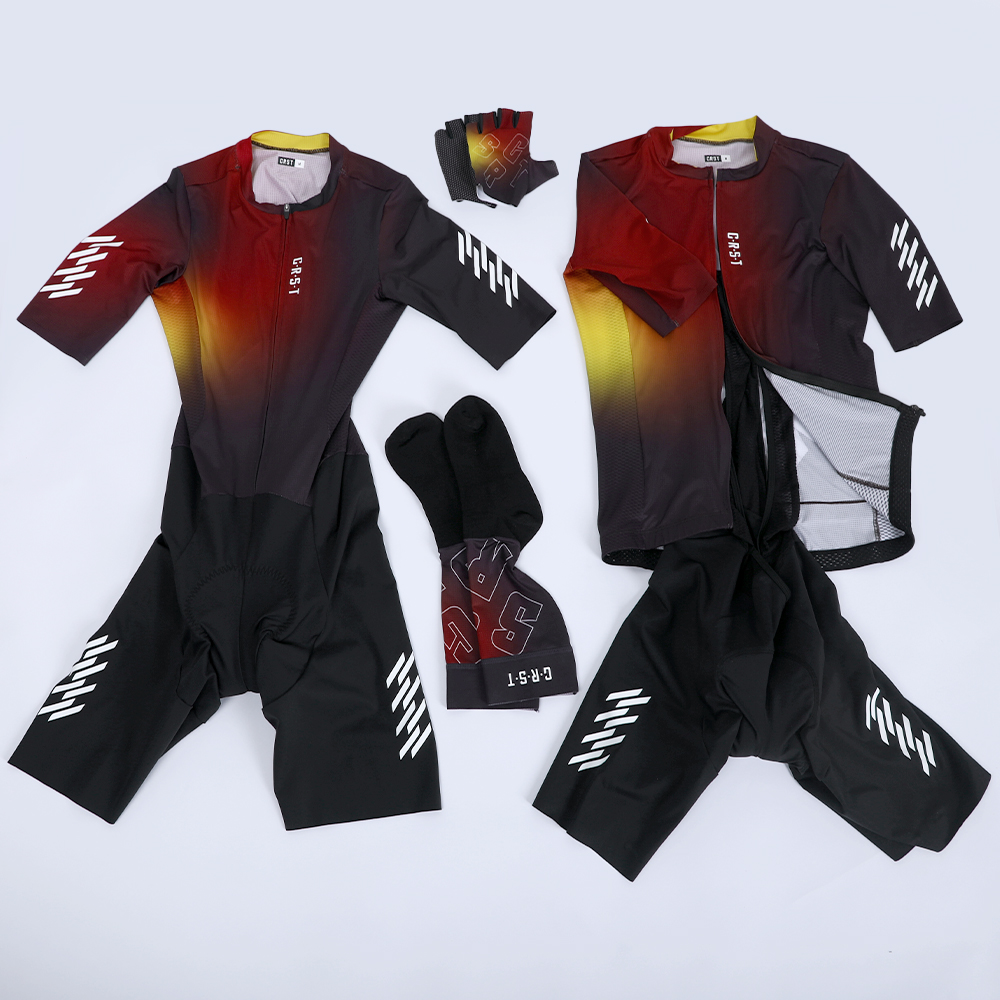
One of the first challenges appears when product lines begin to expand. Many small cycling brands start with a narrow range of products, often focusing on core items such as cycling jerseys or bib shorts. This approach keeps sourcing and production relatively simple. However, as the brand grows, customer expectations usually change. Riders begin to expect more complete product offerings, including cycling socks, base layers, jackets, arm warmers, and other supporting apparel.
Expanding from a few products into a broader collection creates complexity much faster than many brands expect. Each additional category introduces new sizing logic, new material requirements, and new production considerations. A supplier that performs well for cycling jerseys may not have the same level of expertise in compression garments or heavily padded bib shorts. As product variety increases, brands must coordinate more samples, more technical specifications, and more production timelines simultaneously.
This expansion often creates pressure on internal planning. Product line growth is not simply about launching more SKUs. It requires stronger coordination between design decisions, production schedules, and market demand forecasting. Without a structured system, product expansion can quickly become difficult to manage.
As product variety increases, minimum order quantity begins to create additional pressure. MOQ is often manageable when a brand offers only one or two core products. Once multiple categories, colorways, and size ranges are introduced, MOQ becomes far more difficult to balance.
Small cycling brands frequently face a difficult trade-off. Ordering smaller quantities reduces inventory risk but usually increases per-unit cost. Ordering larger quantities improves manufacturing efficiency and pricing, but it also ties up more capital in inventory. This creates a common scaling problem where sales may be increasing, yet cash flow becomes tighter rather than healthier.
This pressure becomes especially visible when brands underestimate how much capital becomes locked inside inventory. Cash is no longer only used for product development or marketing. It becomes distributed across samples, production deposits, material commitments, reorders, and unsold stock. For many growing brands, inventory pressure becomes one of the largest barriers to sustainable scaling.
Contrary to common assumption, the most difficult production stage is not always the first bulk order. Reorders often create even greater operational challenges. Initial production usually benefits from longer planning cycles and more preparation time. Reorders, however, are often urgent and carry higher expectations for consistency.
When demand increases, brands typically need faster replenishment while maintaining identical quality, color consistency, and fit. This creates challenges when materials become unavailable or when production schedules are already under pressure. Even small changes in fabric batches or dye lots can affect product consistency, which becomes increasingly important as a brand builds customer trust.
Reorder complexity becomes particularly difficult when demand is unpredictable. Brands may struggle to estimate how much inventory should be replenished and when reorders should be placed. Ordering too late risks stock shortages and lost sales. Ordering too early increases inventory exposure. Managing this balance requires forecasting systems that many small brands have not yet developed.
Supplier dependency becomes another major factor during scaling. In the early stage of a cycling apparel brand, suppliers often function primarily as vendors responsible for manufacturing individual orders. As the brand grows, this relationship changes significantly.
Manufacturing partners gradually become part of the brand's operational infrastructure. Supplier performance begins to influence launch timing, replenishment speed, production flexibility, and quality consistency. At this stage, supplier selection is no longer only about finding competitive pricing. It becomes a strategic decision that directly affects the brand's ability to scale.
A supplier with limited production flexibility may perform adequately at small volumes but struggle to support growth. Delays, inconsistent quality, or weak communication become more damaging as order volume increases. What once felt like a manageable issue can quickly become a systemic operational bottleneck.
For growing cycling brands, the question eventually shifts from whether a factory can produce apparel to whether that manufacturing partner can support long-term expansion. This distinction becomes increasingly important as brands move into larger production cycles and more demanding delivery schedules.
Another overlooked challenge is that scaling increases operational interdependence. At a small scale, many decisions remain relatively isolated. Product development, inventory planning, and production scheduling may be handled independently or with minimal coordination. Growth changes this dynamic.
A design revision may affect sampling timelines. Sampling delays may affect production scheduling. Production delays may affect launch timing. Launch delays may affect inventory turnover and cash flow. As the business grows, these dependencies become stronger and more interconnected.
This interconnected structure means that small mistakes can produce disproportionately large consequences. A minor communication error during production planning can create delays across multiple departments. A miscalculated inventory forecast can affect both revenue and supplier scheduling. Growth amplifies operational friction.
Because of this, successful scaling requires more than better products or stronger marketing. It requires operational systems capable of supporting larger complexity. Many brands assume growth will be driven primarily by creative design or market visibility. While these remain important, they rarely determine long-term scalability on their own.
Brands that scale successfully typically invest in systems for forecasting, production planning, supplier coordination, and inventory management. These systems help reduce uncertainty and improve decision quality across the business. They also create resilience when market conditions shift or demand fluctuates.
In cycling apparel manufacturing, sustainable growth is often determined by operational discipline rather than product variety alone. Brands that build strong backend systems are better positioned to expand product lines, manage inventory efficiently, and maintain consistent product quality over time.
Small cycling brands rarely struggle because of a single major mistake. In most cases, growth becomes difficult when operational complexity expands faster than the internal system can support. The challenge is not simply producing more apparel or launching more products. The real challenge lies in building a structure that can absorb increasing complexity without losing control.
The brands that scale successfully are often not those with the largest product catalogs or the fastest early growth. They are usually the ones that build reliable systems across product planning, supply chain management, and manufacturing partnerships. In a highly competitive cycling apparel market, sustainable growth depends not only on what a brand sells, but also on how well its operational foundation supports long-term expansion.
We provide scalable OEM & ODM manufacturing support for growing small cycling brands, covering multi-category product development, flexible MOQ solutions, stable batch-consistent reorder supply and long-term strategic supply chain cooperation to lower your inventory and cash flow pressure during brand expansion.
Contact us to build a sustainable manufacturing system matching your brand scaling roadmap.
Email: amytong@tarstone.com
WhatsApp: +86 150 5417 8785
Website: www.tarstone.com
Why Cycling Socks Matter in Long Distance Riding
Cycling Apparel System Guide: How Professional Cycling Kits Are Structured for Performance, Comfort, and Team Consistency