Custom Running Teamwear
A custom running teamwear order usually involves more than choosing a shirt and adding a club logo. Running clubs, teams and event groups often need several garments for different parts of their activities, and those garments still need to look like they belong to the same team.
A race vest may be used for events, while a short sleeve running shirt becomes the main choice for regular training. A long sleeve running top can extend the range into cooler conditions, and running shorts can complete the kit. The right combination depends on how the group actually uses its clothing rather than on a fixed set of products.
For that reason, running teamwear is easier to develop when the whole range is considered from the beginning. Product selection, artwork, branding, quantities and sizing all affect how the final kit comes together.
Decide What the Team Actually Needs
The first decision is not which garment to order, but what the clothing needs to do.
A running club that mainly enters races in warm conditions may have little need for a large collection. A race vest and matching shorts could cover its main requirement. A club with weekly training sessions throughout the year may need a short sleeve running shirt as a more frequently used garment, with additional options for cooler weather.
This difference matters when planning the order. The garment used most often is not necessarily the same garment used on race day, and the quantity of each product does not need to be identical.
A running vest can serve as the main race top for a team that prefers sleeveless clothing during events. A short sleeve running shirt may have a wider role because members can wear it for training as well as organized runs. Long sleeve running tops can be added when the group needs clothing for cooler periods, but there may be no reason to order them in the same quantity as the main team shirt.
Running shorts can be developed alongside the tops when the club wants a coordinated race or training kit. They do not need to repeat the entire upper-body design. Using the same key colours, graphics or branding elements can be enough to make the complete outfit visually connected.
The important point is to start with the team's actual activities. A small running club may need only a few core garments, while a larger organization with regular races and year-round training may have a reason to build a wider range.
Build a Teamwear Range That Works Together
Once the product range has been decided, the next challenge is carrying the team design across different garments.
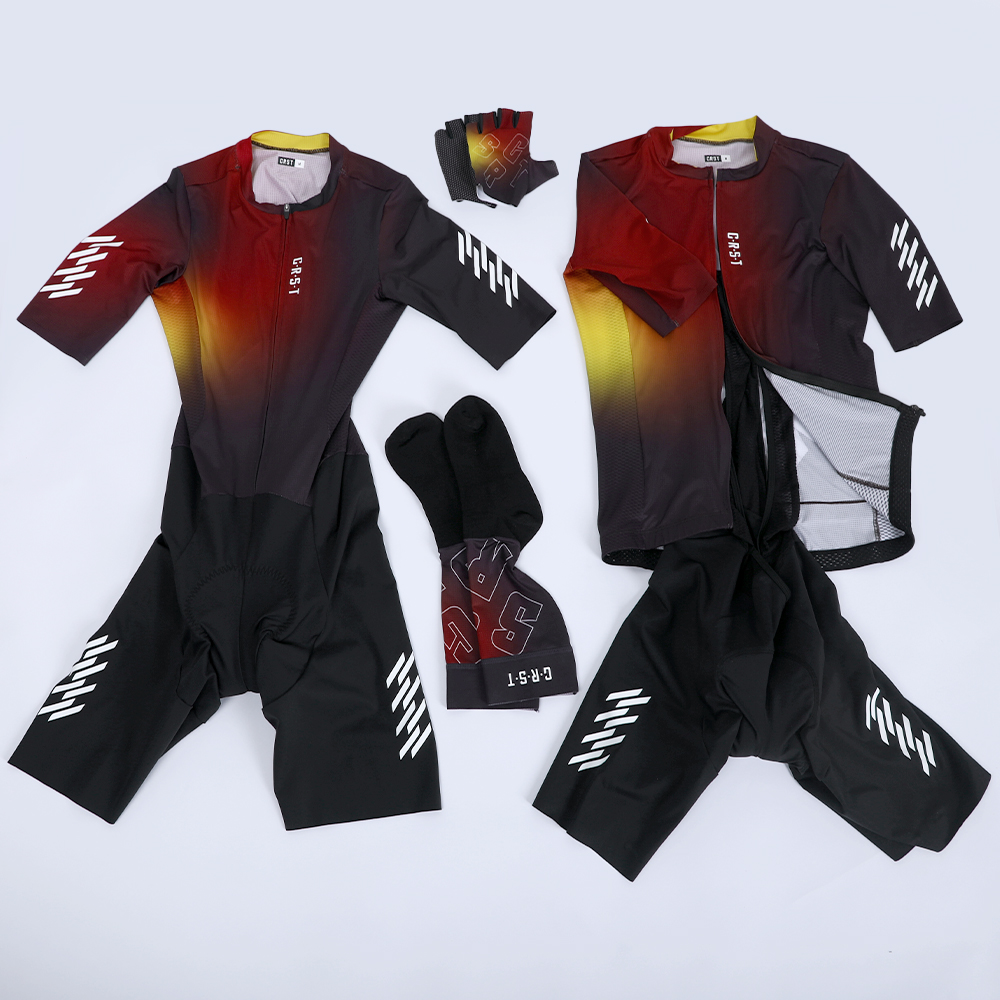
This is where custom running teamwear differs from simply ordering several products with the same logo. The artwork normally needs to be adapted to each garment because the available design areas and proportions are different.
A graphic that works across the front and back of a short sleeve running shirt may need to be repositioned on a running vest. A long sleeve top introduces the sleeves as another design area, while shorts have a much smaller surface for graphics and branding. Simply copying the same artwork onto every product can therefore produce very different results from one garment to another.
The team colour palette can provide the common element. The same colours can be used across the vest, shirt, long sleeve top and shorts even when the graphic layouts are adjusted for each product. This gives the range a consistent appearance without forcing every garment to use an identical design.
Logo placement also needs to be considered across the range. A club logo may have a natural position on the chest of one garment but require a different treatment on another. Sponsor logos create another consideration, particularly when several brands need to appear on the same kit. Their positions, sizes and relationship with the main team graphics should be decided as part of the overall artwork rather than added separately at the end.
The aim is not to make every garment look the same. Each product has its own shape and purpose, so the artwork needs room to work with that shape. What matters is that the different pieces still share a recognizable design direction.
Plan the Order Before Production
After the garment range and artwork direction have been established, the order itself needs to be planned in enough detail for production.
Quantities are one of the first considerations. A club may have the same number of members using its teamwear, but that does not mean every garment will be ordered in equal quantities. A short sleeve shirt used for weekly training may be required by most members, while a long sleeve top may be needed mainly for cooler-season sessions. Race garments may also be ordered according to participation in particular events.
The size breakdown needs to be considered in the same way. The total number of garments does not tell the manufacturer how the order should be divided between sizes, and the breakdown may differ between products. Confirming these requirements before production helps avoid changes once the order is already being prepared.
Artwork approval is another important stage. When a team is ordering several garment types, the final artwork should be checked on each product rather than approved only from the main shirt design. A graphic may need to be moved, resized or rearranged when it is applied to a different garment shape.
For teams working toward a particular race or event, production timing also needs to be considered early. The schedule may include design confirmation, sample development and approval before bulk production starts. Leaving these stages until close to the event can make the overall schedule more difficult to manage.
Clear information at the beginning of the order gives both sides a better understanding of what is being produced. The garment selection, quantities, size requirements, approved artwork and required delivery date should all be established before the bulk order moves into production.
Turn Individual Garments Into a Complete Team Kit
A complete running teamwear range does not have to include every possible garment. What makes it work is the relationship between the products that are actually included.
A club may use a running vest as its main race garment, a short sleeve running shirt for regular training and a long sleeve top when conditions are cooler. Another club may need only a race top and shorts. Neither approach is automatically right for every team.
The same principle applies to the design. Different garment shapes require different artwork layouts, but the overall identity can remain consistent through the use of team colours, logos, graphics and sponsor branding. This is particularly important when several products are produced at the same time, because small differences in colour or graphic treatment can make separate garments look unrelated.
Planning the range together also makes future additions easier to handle. If a club later needs another garment, the existing design direction provides a reference for developing it without starting the visual identity again from the beginning.
For brands, running clubs and teams ordering custom running apparel, the objective is therefore not simply to produce several garments with the same logo. It is to create a practical range in which each garment has a clear purpose and the products still work together as one team kit.
Conclusion
Custom running teamwear is most effective when the range is planned around the team's real activities rather than around a standard collection of garments.
The choice between running vests, short sleeve shirts, long sleeve tops and shorts depends on how the clothing will be used. Once those requirements are clear, the artwork can be adapted across different garment shapes, while quantities, sizing and production timing can be confirmed before bulk production begins.
A well-planned teamwear order brings those decisions together so that the finished garments are practical for the team and consistent in appearance.
Custom running teamwear is more than printing logos on separate garments. A cohesive running kit starts with understanding the team’s real use cases for training, racing and different weather conditions.
You can keep unified brand visuals across vests, short/long sleeve tops and shorts, while adjusting artwork layout for each garment’s shape. Planning quantities, size breakdown, artwork approval and lead time upfront helps avoid delays and inconsistencies during bulk production.
Tarstone delivers full‑cycle custom running teamwear OEM & ODM service: custom running vests, shirts, long sleeve tops and shorts, sample iteration and stable bulk production for running clubs, race teams and event groups.
Ready for your custom running teamwear project? Request formal quotation today.
Email: amytong@tarstone.com
WhatsApp: +86 150 5417 8785
Website: www.tarstone.com
Related Article